
How to Check If Your Ingredient Is a Novel Food (UK)
You have probably landed here because someone else asked the question first. Your contract manufacturer wants evidence of novel food status before they will run the batch, or a retailer’s technical team has asked for it during onboarding, or you searched the ingredient yourself and found three confident answers that contradicted each other.
The rule is straightforward: if a food or ingredient wasn’t consumed to a significant degree by people in the UK or the EU before 15 May 1997, it is a novel food, and it needs authorisation before it can be sold. That is Regulation (EU) 2015/2283, retained in Great Britain after Brexit.
While the rule may be specific, it doesn’t always make it easy for brands to apply it to their own product, and unfortunately this is one of the expensive ones to get wrong. Wording can be rewritten, but an ingredient cannot. A novel foods problem doesn’t just cost you the formulation, it takes the print run and the launch date with it.
The short version
- The test is whether it was eaten here, in the UK or the EU, before 15 May 1997. A long history somewhere else doesn’t count towards it.
- Safety isn’t the question. An ingredient can be entirely safe, natural and widely sold, and still be novel.
- A familiar plant can be made novel by what you do to it, so the part you use, the extraction method, the concentration and the format your product takes all change the answer.
- The EU novel food catalogue is a guide rather than a ruling, and the Food Standards Agency (FSA) won’t confirm status informally.
- “Already selling on Amazon” and “my supplier says it’s fine” are not evidence, because the responsibility for establishing status sits with you.
- Authorised isn’t the same as unlimited, and clearing novel foods says nothing at all about what you can then claim.
What counts as novel
Most founders picture something exotic when they hear novel food, but the category is far broader than that, and the surprises are usually ordinary plants.
The first thing to be clear about is where the eating had to happen. The test is consumption in the UK or the EU before 15 May 1997, so traditional use in Asia, Africa or South America doesn’t satisfy it, however long or well documented that history is. This catches a lot of botanicals with centuries of use behind them, and it can feel unfair, but the regulation is only interested in European dietary history, not in whether the ingredient is safe.
The second thing is that consumption has to have been significant. One importer bringing in a small quantity, or a specialist shop stocking it for a particular community, isn’t enough. And the burden of demonstrating that history sits with you, not with the authority.
And the third is that a familiar ingredient can be made novel by what you do to it. A new extraction method, a new solvent, a concentration nobody was eating in 1997, any of these can create a novel food out of something people have eaten for generations. The plant is traditional; your ingredient is not. Many brands get caught out here because a change of extract or a change of supplier can move your position without changing a single word on the label.
So the question is never simply “is turmeric a novel food”. It’s whether your species, your plant part, your extract, at your concentration, in your product format, has that UK or EU history of consumption.
There is one route that gives that history somewhere to go, though it’s narrower than most people hope. A traditional food from a third country can be notified rather than put through a full application, if you can show compositional data and at least 25 years of continued use in the customary diet of a significant number of people in at least one country outside the EU. The catch is that it has to be derived from primary production, so the raw material may qualify where your concentrated extract of it does not, and it still ends with the food being authorised and added to the list. It’s a faster assessment, not a way round the queue.
How to check your ingredient’s novel food status
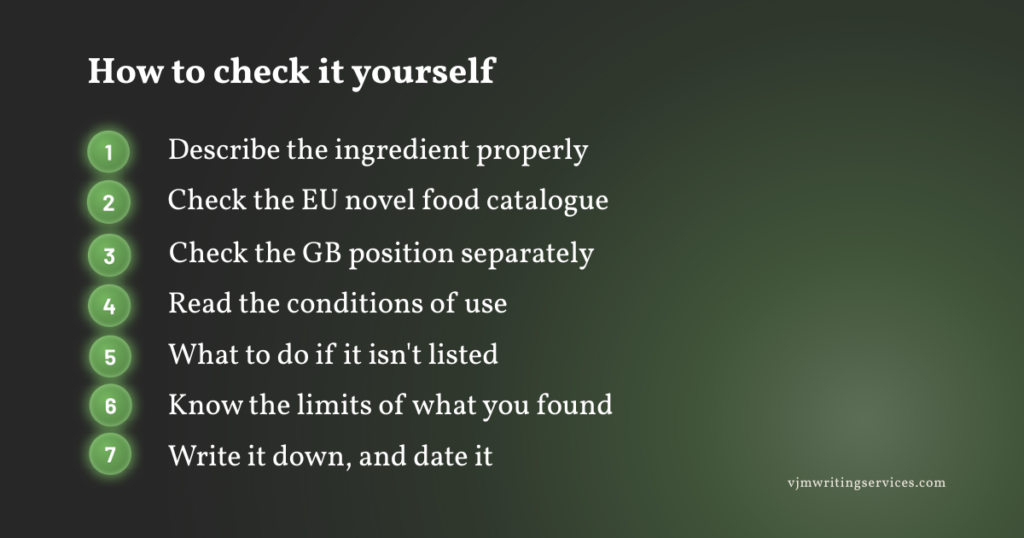
- Describe your ingredient properly. Latin binomial, plant part, extraction solvent, extract ratio or standardisation, and whether you’re selling it as a food or a food supplement. Most specification sheets from ingredient brokers won’t give you all of that, so expect to ask, and expect the answer to take a while to come back. The check can’t start until you have it, because every one of those details can change the answer.
- Check the EU novel food catalogue. It lists thousands of ingredients and it’s the fastest way to get an early read. Entries are organised by species, and a single species can carry more than one position, split by plant part, by extraction method, and sometimes by whether the product is a food or a food supplement. So read the whole entry, because the line that applies to you may be the third one down.
- Check the GB position separately. Great Britain now runs its own authorisation system through the FSA and Food Standards Scotland (FSS), with authorised novel foods published on the GB register. The GB and EU positions have diverged since 2021, so if you’re selling into both you need to check both. The FSA also publishes the outcomes of completed Article 4 consultations, which is a free and under-used source of determinations on specific ingredients.
- Read the conditions of use, not just the status. Authorised ingredients usually come with conditions attached: which product categories they can go into, maximum levels, and sometimes mandatory labelling. An ingredient can be authorised and your product still be non-compliant, if you’ve used more than the authorisation allows.
- Work out what to do if it isn’t listed. This is where most people get stuck. If you have evidence of significant consumption in the UK or EU before 1997, you can ask for a formal determination through an Article 4 consultation, which decides whether your product is novel and isn’t the same as applying for authorisation. If you have no such evidence, there’s nothing to consult about, and you should work on the basis that the ingredient is novel until you can show otherwise. Either way, start by asking your supplier what evidence they hold, because they may already have it.
- Understand the limits of what you’ve found. The catalogue isn’t a legal ruling and it isn’t exhaustive, so a favourable entry won’t protect you if an authority takes a different view. What it does tell you is how member states read the regulation, and it’s the first place your manufacturer, your retailer’s technical team and an enforcement officer will each look.
- Write down what you found, and when. Status moves: authorisations are granted, applications are withdrawn, catalogue entries are updated. A dated record of what you checked and where is what you hand over when a manufacturer or a retailer asks, and it’s what stops you starting the whole exercise again in eighteen months when a supplier changes and nobody can remember what was decided the first time.
Where the check goes wrong
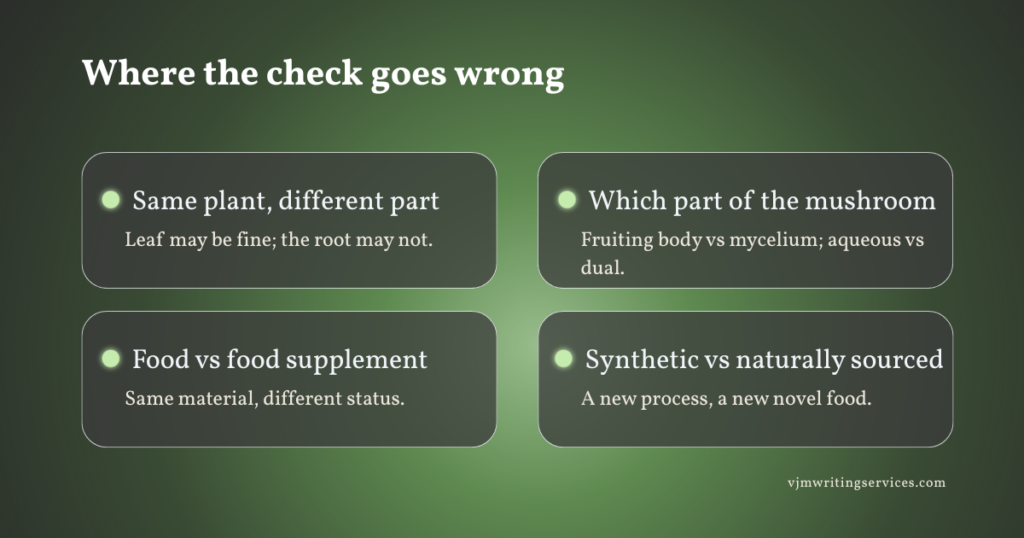
Same plant, different part. History of consumption attaches to what was eaten, not to the species in general. Leaves, roots, seeds and aerial parts can all sit in different positions, so a formula that names only the plant isn’t telling you enough to know where you stand.
Which part of the mushroom, and which extract. This one catches functional mushroom brands constantly. For lion’s mane and reishi, the catalogue records the fruiting body and aqueous extract powder as not novel in food, but dehydrated mycelium powder as a novel food needing authorisation, because the history of consumption couldn’t be established for the mycelium the way it could for the fruiting body. A lot of the cheaper mushroom material on the market is mycelium grown on grain, so this is a real question for your specification rather than a technicality. And the entry covers aqueous extract only, so the ethanol and dual extracts that many premium suppliers sell aren’t covered by it either way. Read the scope line while you’re there, because some entries clear an ingredient for food generally and others only for food supplements.
Food versus food supplement. The same material can be established in one format and novel in another, because a supplement dose and a food portion are different exposures, and the catalogue often records them separately. The intended use is part of the question, not context around it.
Synthetic versus naturally sourced. A compound that occurs in food isn’t automatically cleared when it’s manufactured synthetically, because what matters is whether that form has the history, and a new production process can create a new novel food out of a familiar molecule.
What this looks like on a real formulation
Say you’re working on a pre-launch focus and energy powder with three actives in it: a lion’s mane extract, citicoline and NMN. All three need checking, and the answers come back differently, which is fairly typical.
The lion’s mane depends on what the specification sheet says. If it’s the fruiting body, or an aqueous extract powder made from it, the catalogue has it as not novel in food and you’re on comfortable ground. If it’s dehydrated mycelium powder then it’s a novel food and it needs authorisation before you can sell it. And if it’s a dual extract, you’re outside the entry that gave you the comfort in the first place. None of that is visible from the words “lion’s mane extract” on a supplier’s price list, which is why the specification matters more than the ingredient name.
The citicoline is authorised, with conditions. This looks like the straightforward one, and it’s the one that most often catches people out, because being authorised isn’t the end of it. Authorisations come with conditions attached, covering which categories the ingredient can go into and how much of it you can use, so if your serving goes over the permitted level then the ingredient is authorised and your product still isn’t compliant.
Unfortunately, the NMN is the one that stops you. It’s a novel food, it hasn’t been authorised in GB or the EU, and it’s on sale here while it’s under assessment, so you can buy it, sell it and ship it today and it still isn’t authorised.
So the outcome isn’t a straight yes or no. You’re looking at reformulating one ingredient, capping the dose on another, and making a commercial decision about how much risk you want to carry on the third, which is a much easier conversation to have now than after the packaging has been printed and the first batch manufactured.
“My supplier says it is not a novel food”
Your supplier’s assurance doesn’t transfer the risk. As the business placing the food on the market, the responsibility for establishing status sits with you, and a line in an email from an ingredient broker won’t carry any weight with an enforcement officer, a retailer’s technical team or a contract manufacturer’s quality department.
What does carry weight is documentation: a history of consumption dossier, the catalogue entry with its qualifiers, the authorisation reference where one exists, or the outcome of an Article 4 consultation. A history of consumption dossier is simply the evidence that the ingredient was being eaten here before 1997, assembled and set out: import records, trade data, product catalogues, retail listings, published literature, anything that shows real consumption rather than availability. It’s a research exercise rather than a laboratory one, which is why it costs a fraction of a safety dossier.
If your supplier has that evidence, ask for it. If they only have an opinion, treat it as an opinion.
Ask in writing, ask for the evidence rather than the conclusion, and keep the reply. What you want is the document, not the reassurance, and a supplier who has done the work will send it without much fuss. One who hasn’t will send you a paragraph about how long the ingredient has been on the market, which tells you what you need to know.
The same goes for the argument that an ingredient must be legal because it’s already on sale. Enforcement is patchy and reactive, and the fact that a competitor hasn’t been caught tells you nothing about your own exposure. It’s exactly the reasoning that gets probiotic listings pulled on Amazon, and it fails for the same reason: nobody has looked at your product yet.
Under assessment is not the same as authorised
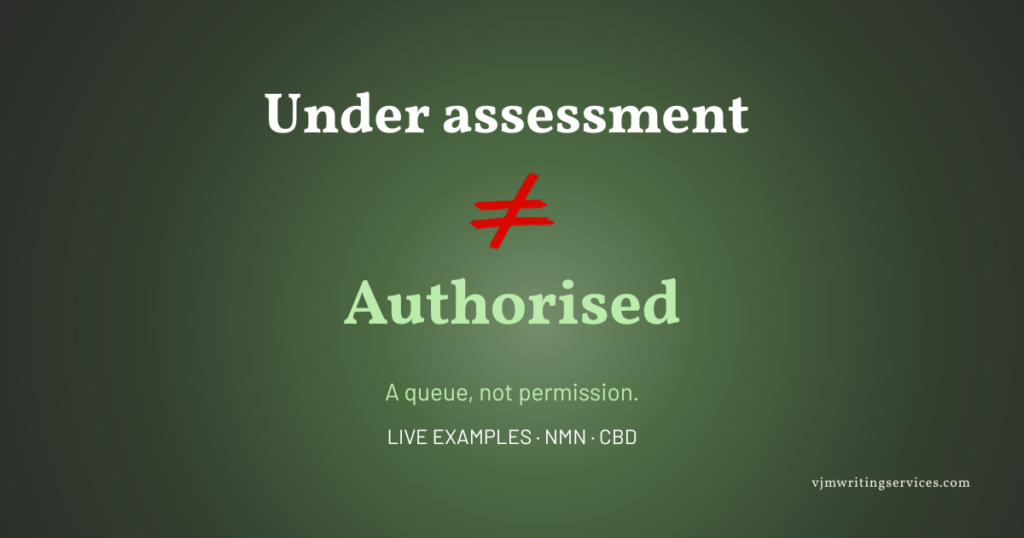
This is the point that causes the most confusion, and NMN (nicotinamide mononucleotide) is the clearest example of it.
It’s a novel food, it has applications in progress, and it hasn’t been authorised in GB or the EU. It’s also on sale in half the longevity stacks you’ll look at, which is exactly why founders assume it must be fine. The EU is where that assumption falls over: same ingredient, same regulation, and it came off shelves once member states started enforcing. Nothing changed about the evidence. Someone just looked.
CBD (cannabidiol) makes the other half of the point. The FSA opened a route for it back in 2020, hundreds of products got themselves onto the public list, and years later there is still no authorised CBD ingestible in GB. Being on that list has never meant the product was authorised, only that it was linked to an application still being assessed, and products have been removed from it along the way. At EU level CBD is still not on the Union list either. So if an application with that much money and that many lawyers behind it hasn’t landed after six years, an application is not a plan.
The important thing is what an application does and doesn’t do. It doesn’t make the ingredient legal. Until an authorisation is granted, an unauthorised novel food is unlawful to place on the market, and the fact that plenty of brands are doing it anyway is a description of how much enforcement there is, not of what the rules say.
And enforcement isn’t the only thing standing between you and a launch. The people who look hardest at this are commercial: the contract manufacturer deciding whether to run your batch, the retailer’s technical team during onboarding, the marketplace running its compliance checks, the investor doing due diligence before a raise. None of them accepts “there’s an application in” as an answer, because none of them wants to carry your risk. A brand built on a queued ingredient can be perfectly saleable direct to consumer and completely unable to move into retail.
Northern Ireland is not the same market
Northern Ireland follows EU novel foods rules, while England, Scotland and Wales follow the GB regime, so “UK-wide” isn’t a regulatory category. The two have been drifting apart since 2021, because EU decisions taken after 1 January 2021 don’t apply in GB.
The EU has authorised a steady stream of novel foods since divergence, so an ingredient is more often fine in Belfast and not in Cardiff.
And you don’t decide to enter the Northern Ireland market, your checkout does it for you. If your store ships anywhere in the UK, you’re already selling into a jurisdiction with different rules, and if Northern Ireland is in scope, the EU catalogue and EFSA are your reference points for that part of the business, not the GB register.
If you’re already selling it
Plenty of people reach this article with the product already on the market, which is a different problem from the pre-launch one, and panic isn’t the right first move.
Establish what you have before you do anything else. Get the full specification, work out whether the issue is the ingredient, the extract, the dose or the format, and write down what you find with dates and sources. A fair number of apparent problems turn out to be a specification nobody had read properly.
Then be honest with yourself about how much risk you’re carrying, because the answer differs enormously between an ingredient that’s authorised at a lower dose than yours and one that has never been authorised anywhere. The first is a reformulation at your next production run. The second is a decision about whether to keep selling, and it comes with a real tail: formally, placing an unauthorised novel food on the market is a breach of food law, enforced by local authorities and Trading Standards, and the usual outcome is withdrawal from sale.
Talk to your manufacturer early rather than late. They’re the party most likely to stop production, and they’ll be considerably more helpful if you raise it than if they find it.
And if a retailer or a marketplace has already asked the question, answer it with documentation rather than reassurance. What they need is evidence of status, not your confidence in the ingredient.
If it is novel, you have three options
Reformulate. Usually the cheapest answer by a distance, and often achievable without losing the point of the product. It might mean moving from a dual extract to an aqueous one, dropping a dose to sit inside an authorisation, or swapping the ingredient for one with an established position that does a similar job. Before you commit to artwork and a batch it’s a conversation with your manufacturer. After that, it’s a write-off.
Restrict the market. Sell where the ingredient is authorised and build the launch around that, rather than around a hope that authorisation lands. For several longevity ingredients the honest answer is that the United States is the viable first market and GB isn’t.
Apply. Realistic for very few businesses. There’s no application fee, so the cost is in the dossier rather than the process: a full safety package, the toxicology behind it, and a timeline measured in years rather than months. Unless the ingredient is proprietary and you have the resources to protect it, the arithmetic rarely works for a founder-led brand, and it’s a poor answer to “we’re launching in the spring”.
Checking early is what keeps all three of these options on the table. Leave it until the artwork is printed and the first batch has been made, and you’re writing off packaging and stock rather than changing a line on a specification.
What changed in 2026
Two changes to how approvals work, both of which affect timing rather than the rules themselves.
The first is about how an authorisation becomes law. Until recently, every approved novel food had to be written into legislation before it could be sold, which meant waiting for parliamentary time on top of the scientific assessment. Approvals now go onto a public register instead, so once a product has been assessed and cleared, it can be listed without that extra step.
The second is that products already authorised as safe no longer have to be renewed, which takes a repeat administrative exercise out of the system for ingredients that were never in doubt.
In March 2026 the FSA and Food Standards Scotland also published updated guidance on the authorisation process, including what to do before you apply.
None of this changes the test your ingredient has to pass. It changes how quickly the queue moves, which matters if you’re waiting on someone else’s application, and matters not at all if your ingredient has never been assessed.
Legal to sell is not legal to claim
This is where brands most often relax too early. Clearing novel food status establishes that your ingredient can lawfully be in the product. It says nothing at all about what you’re allowed to say about it.
The two run on completely separate rules. Novel foods is about whether the ingredient can be sold at all, and health claims are about what you can tell people it does, so an ingredient can sail through the first and leave you with nothing on the second. That happens more often than founders expect, because the ingredients people build brands around, the ones with a story and a mechanism, are usually the ones with no authorised claim behind them.
That’s the situation for most of the longevity and cognitive category. The ingredient is fine, and there’s no compliant way to say why anyone should buy it, which is a difficult conversation to have after the formulation is locked and the packaging is at the printer.
Before you commit to a formulation
We review formulations for market access, covering novel foods status, permitted forms, conditions of use, safe upper levels and the technical file evidence you’ll be asked for, so the question gets answered before the ingredient is bought and the packaging is printed.
And once the formulation is finalised
A Claims Bank sets out what you can and cannot say about it: every claim available to you at your doses, in your market, with the wording that holds up, and a clear list of what is off the table. £295 for one SKU in one market, with further SKUs and markets quoted separately.
Email us at info@vjmwritingservices.com and tell us what you’re working on.
If you are a formulator, sourcing consultant, manufacturer or packaging designer, and novel foods questions keep landing on your desk from clients, here is how we work with partners.
Partners page →
Formulation compliance review →
FAQ
Sources
- Regulation (EU) 2015/2283 on novel foods, retained in Great Britain
- FSA, Novel foods authorisation guidance, including the Article 4 consultation route: https://www.food.gov.uk/business-guidance/regulated-products/novel-foods-guidance
- FSA, Outcomes on novel food consultations: https://www.gov.uk/government/publications/outcomes-on-novel-food-consultations/outcomes-on-novel-food-consultations
- FSA, Novel food authorisations register: https://data.food.gov.uk/regulated-products/novel_authorisations
- European Commission, Novel Food Catalogue and Union list of authorised novel foods: https://food.ec.europa.eu/food-safety/novel-food/authorisations/union-list-novel-foods_en
- FSA, Reforms to the market authorisations process for regulated products (in force 1 April 2025): https://www.gov.uk/government/publications/reforms-to-the-market-authorisations-process-for-regulated-products/reforms-to-the-market-authorisations-process-for-regulated-products
- Commission Implementing Decision 2014/423/EU authorising citicoline as a novel food ingredient: https://eur-lex.europa.eu/legal-content/EN/TXT/?uri=CELEX:32014D0423
- EFSA, Safety of beta-nicotinamide mononucleotide (beta-NMN), scientific opinion published 11 May 2026: https://efsa.onlinelibrary.wiley.com/doi/10.2903/j.efsa.2026.10007
- EFSA, Guidance on notifications and applications for traditional foods from third countries, Articles 14 and 16 of Regulation (EU) 2015/2283
- FSA, CBD products linked to novel food applications, the England and Wales public list: https://www.gov.uk/government/publications/cbd-products-linked-to-novel-food-applications/cbd-products-linked-to-novel-food-applications
Written by Victoria Metzger, VJM Writing Services. Former NHS registered dietitian, now working on claims strategy and compliance for supplement brands across the UK, EU and US. Scientific substantiation on every project is handled by Richard Metzger, pharmacologist. This article is general information about how the rules are applied, not legal advice on any specific product.
Last reviewed: August 2026.