
Why Amazon took down your probiotic listing
If Amazon has pulled your listing on amazon.co.uk, the likeliest cause is one word: probiotic. In Great Britain, and at EU level, that word is treated as a health claim, and it’s not an authorised one. Amazon does not assess that question product by product. It sees a flagged term, and the listing goes down.
Nothing is necessarily wrong with your product. The problem is what your listing says about it.
The short version
- “Probiotic” implies a health benefit, so it counts as a health claim under Regulation (EC) No 1924/2006, which still applies in GB.
- No probiotic health claim has ever been authorised on the register.
- The ASA has ruled on this repeatedly, including where the word sat inside the product name.
- Amazon enforces at keyword level rather than case by case, so the listing comes down regardless of your evidence.
- To get it back, the word must come out of every field, including your images and backend search terms, and it cannot be swapped for another unauthorised claim.
Why “probiotic” is a claim, not a description
On the face of it, “probiotic” is just the name of a product category, but regulators don’t read it that way. The word carries a promise, that the live bacteria inside do something useful for your health, and anything that implies a health benefit is a health claim.
Health claims can only be used if they are authorised. Since 1 January 2021, that means they must be listed on the Great Britain Nutrition and Health Claims Register (GBNHCR) for the GB market. Unfortunately, there are no probiotic claims on it. Applications have been unsuccessful, because the evidence has not tied a specific effect to a specific strain at a specific dose, which is the standard EFSA applies.
The word itself has been treated as the problem, not just what surrounds it. European Commission guidance gives “probiotics” as an example of naming a substance in a way that indicates a functional effect. Department of Health guidance took the same stance. The ASA has followed it: in 2014 it told an advertiser that “probiotic strains”, “probiotic bacteria” and “probiotic formula” were health claims in themselves, and in 2023 it upheld complaints against a supplement called Smart Probiotic, on the basis that the word in the product name would be read as describing something that contributed to gut health.
The exception someone will point you to
Ask around and someone will tell you there is a way round this. They are half right, and that is why the position looks inconsistent from the outside.
A general, non-specific health claim is permitted if it is accompanied by a relevant authorised specific health claim. That is Article 10(3) of the regulation, mirrored in CAP rule 15.2, and it is a real route that brands use every day for other ingredients. The catch sits in the word relevant. You need an authorised claim that actually fits your product, and for probiotics there is almost nothing to reach for. The nearest thing is the claim for live yoghurt cultures improving lactose digestion, which came out of a 2010 EFSA opinion and does not use the word probiotic at all.
So if you sell a live yoghurt or a fermented dairy drink, that pairing can work, and some brands do use it. If you sell a multi-strain capsule for gut health, there is nothing to pair with, because the authorised claim is about yoghurt cultures and lactose, and your product is neither.
That is what the 2023 rulings turned on. The ASA has never said the word can never appear, it said the general health claims were not accompanied by an authorised specific claim, and that is what breached the Code. Worth knowing before you spend a fortnight chasing an exception that was never going to reach your product.
Why Amazon pulls your listing instead of arguing
Amazon is not a regulator, but it carries responsibility for what sells on its marketplace, and it operates at scale which means it’s near impossible to weigh every product on its merits. So, enforcement is blunt: a flagged term means a suppressed listing, and nobody is sitting reading your evidence file.
This is why the takedown notification often feels like it came out of nowhere. Your listing got picked up by a keyword filter, and that can happen automatically or because someone (sometimes a competitor) reported it.
It’s rarely a sign that you’ve done anything reckless. “Probiotic” is the most obvious word for these products, which is precisely why it catches out careful brands.
It’s also why appealing on the science tends to go nowhere, because the decision was not made on the science in the first place.
Where the word hides
Editing the title and resubmitting is the most common wasted afternoon in this process. The word has to come out of everywhere:
- Title, bullets and product description
- A+ content modules
- Text baked into images, infographics and lifestyle graphics
- Backend search terms and other keyword fields
- Variation and parent listing titles
- Sponsored Products and Sponsored Brands copy
- Photographs of your packaging, if the pack itself carries the word
If the word is in your registered brand name or product name, you are in harder territory. This requires a decision about the brand, and it is worth taking advice before you start renaming things in Brand Registry.
My competitor still says “probiotic”, so why can’t I?
Three things are usually going on.
Some sellers just haven’t been caught. Enforcement is patchy and often only starts when someone complains, so “they’re getting away with it” tends to mean “not yet”.
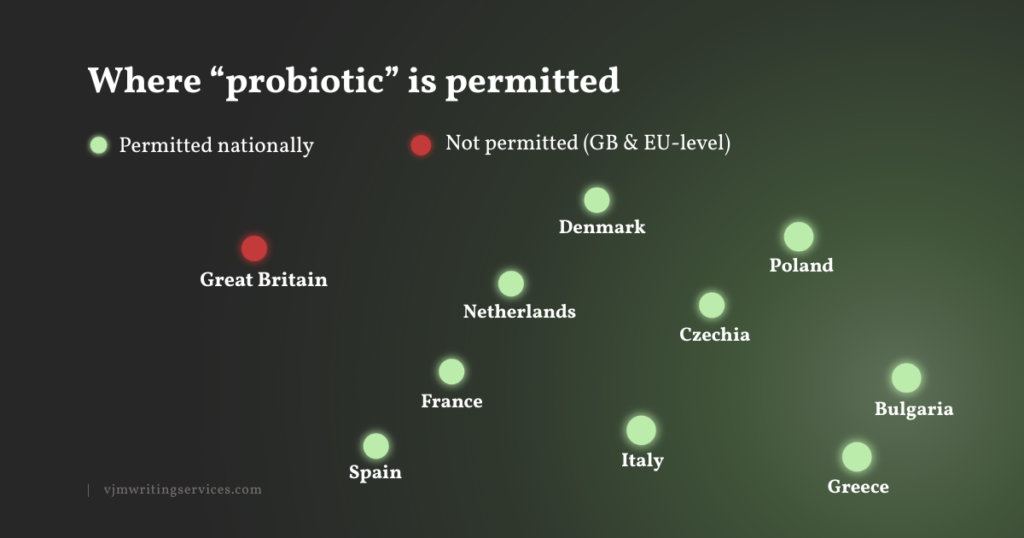
Some are selling in countries that permit the term nationally. A growing list of member states now accepts “probiotic” on food supplement labels, including Italy, Spain, France, Denmark, the Netherlands, the Czech Republic, Poland, Greece and Bulgaria, on differing legal bases.
Italy allows it against specific conditions on strain characterisation, viability and dose. Denmark and France treat it as a mandatory category designation under the Food Supplements Directive. Spain allows it through mutual recognition. The EU-level position hasn’t moved with them, and neither has GB, so amazon.it and amazon.es are not the same regulatory environment as amazon.co.uk, even for the same product.
And the US runs on a different system entirely, with structure and function claims under DSHEA and substantiation policed by the FTC. A listing that runs on amazon.com will not necessarily survive on amazon.co.uk.
Either way, a competitor listing is a poor guide to what you can say. You don’t know which market it was written for, or whether it is simply next in the queue.
How to get the listing reinstated
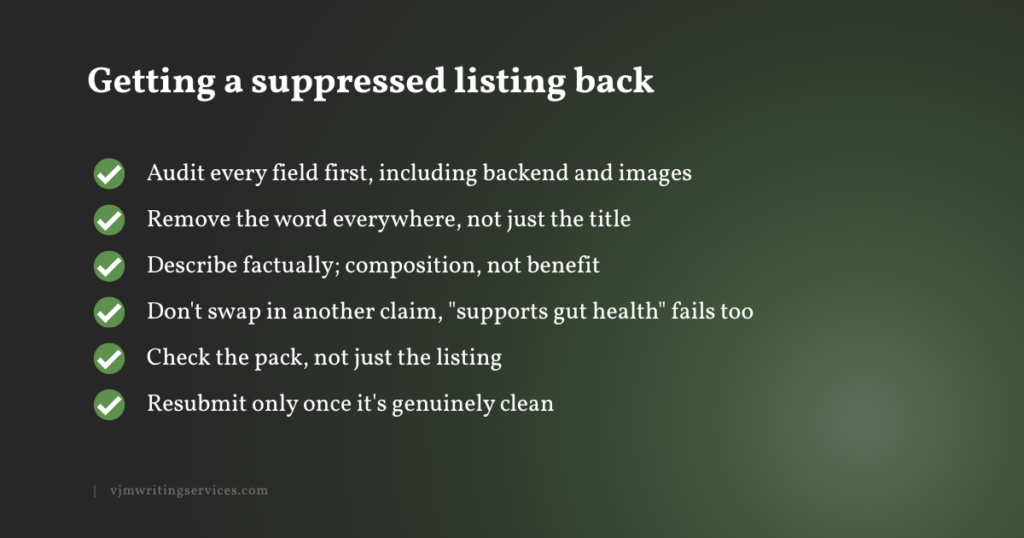
- Audit every field before you touch anything, including the backend and the images. Work from a copy of the listing, not from memory.
- Take the word out of all of it.
- Describe the product factually instead. Naming what is in it is not a claim: “contains Lacticaseibacillus rhamnosus, 10 billion CFU per capsule at end of shelf life” states composition, not benefit.
- Watch what you reach for as a replacement. “Supports gut health”, “aids digestion” and “restores your microbiome” are health claims too, and they need authorised wording behind them. Swapping one unauthorised claim for another gets you suppressed a second time, and the violations stack up on your Account Health.
- Know the limits of the workaround. Much of the UK industry moved to “live cultures” or “live bacteria” after the early ASA rulings, on the basis that being alive is not in itself a health benefit. It is more defensible than “probiotic”, but it is not a free pass, because context still counts and surrounding gut health copy can pull a neutral phrase back into claim territory.
- Check the pack, not just the listing. If “probiotic” is printed on the label itself, cleaning up the listing fixes nothing, because the pack is carrying an unauthorised health claim wherever it is sold, whether that’s Amazon, a retailer or your own site. At that point you are looking at a label change, not a copy edit.
- Resubmit once the listing is genuinely clean. If it stays blocked, the flagged term is still in there somewhere.
Reviewing listings for high-risk copy is one of the things we do. If you want yours looked at properly, email the ASIN to info@vjmwritingservices.com and we’ll come back to you on scope and cost.
The takedown is the symptom
Reinstating the listing is the quick fix. The reason it came down is the more expensive problem: the messaging was written before anyone checked what could be said about the product.
That is the pattern behind most takedowns, and it is far cheaper to settle the claims before you list than to rebuild a listing, a pack and an ad account afterwards. If you are not sure which of your claims are safe and which are exposed, pressure-test them before your next launch rather than after your next suppression.
If a listing has already been pulled
We audit Amazon listings for high-risk copy across every field, including A+ modules, image text and the backend, and come back with what has to change and how to fix it. From £495. If you’d rather we rewrote the copy than flagged it, we can quote for that once we’ve seen the listing. Email the ASIN to info@vjmwritingservices.com.
If you would rather not find out this way
A Claims Bank sets out what you can and cannot say about your formulation before anyone writes the copy: every claim available to you at your doses, in your market, with the wording that holds up, and a clear list of what is off the table. £295 for one SKU in one market, with further SKUs and markets quoted separately. It’s the document your listing, your label and your ad account should all be written from.
If you are a formulator, sourcing consultant, packaging designer or agency and this keeps landing on your desk, here is how we work with partners.
Partners page →
FAQ
Sources
- ASA CAP Advice Online, Food: Probiotic claims. https://www.asa.org.uk/advice-online/food-probiotic-claims.html
- ASA CAP Advice Online, Claims in product names. https://www.asa.org.uk/advice-online/claims-in-product-names.html
- ASA ruling, Smart Probiotic, 31 May 2023.
- ASA ruling, Willys Ltd, 15 March 2023.
- Regulation (EC) No 1924/2006 on nutrition and health claims made on foods, Articles 10(1) and 10(3).
- Great Britain nutrition and health claims register, and DHSC guidance on compliance with Regulation (EC) 1924/2006.
- IPA Europe, European legal framework, on national positions and their legal bases. https://www.ipaeurope.org/legal-framework/european-legal-framework/
- ISAPP, “Probiotic” on food labels in Europe, on the live yoghurt cultures and lactose digestion claim. https://isappscience.org/probiotic-on-food-labels-in-europe-spain-adopts-a-pioneering-initiative/
- NutraIngredients, on UK brands moving from “probiotics” to “live bacteria” after ASA action.
Written by Victoria Metzger, VJM Writing Services. Former NHS registered dietitian, now working on claims strategy and compliance for supplement brands across the UK, EU and US. Scientific substantiation on every project is handled by Richard Metzger, pharmacologist. This article is general information about how the rules are applied, not legal advice on any specific product.
Last reviewed: August 2026.